Strata Industrial Units Singapore: Loading-Bay Provisions and Trade Fit
When people talk about industrial property in Singapore, the conversation often jumps straight to yield and price. Those matter, but with strata industrial units, what quietly determines your day-to-day success is https://harrietchewynt.wordcanopy.com/posts/space-nova-new-launch-buyer-faq-from-location-to-pricing-pages less glamorous. It is whether the unit’s loading-bay provision matches your actual workflow, and whether your trade can operate within the approved B1 (or B2) use quantum without constant friction.
I have seen tenants who can afford the rental, but struggle because the logistics plan was optimistic. A “small adjustment” during fit-out becomes a costly scramble later, especially when you are trying to align truck access, goods-lift movement, and the practical rhythm of loading and unloading. With strata industrial units Singapore, those details are not just technical. They shape whether the space feels functional at 7 a.m., or becomes a daily bottleneck.
This article focuses on the two issues that usually separate a smooth operating year from a stressful one: loading-bay provisions and trade fit, with a particular lens on B1 industrial property Singapore and how that zoning reality flows into what you can actually do inside a unit.
The zoning reality that governs what you can do
B1 industrial zoning is intended mainly for clean industry, light industry, warehouses, public utilities and telecom uses. The planning logic is straightforward: many B1 uses are meant to avoid nuisance and keep a buffer. The verified guidance also notes that uses that need a nuisance buffer of more than 50m are generally not allowed, while some general industrial uses may be considered case by case if buffer requirements are met.
What trips up buyers and tenants is that B1 is not a free-for-all “industrial, but flexible” label. There is also a use-quantum rule. URA guidance states that at least 60% of the floor area or GFA in a B1 development or strata unit must be used for industrial purposes. The remaining area is limited to ancillary or supporting uses and approved secondary uses. That means your business model cannot treat the unit as mostly storage for non-industrial activities, nor can it rely on a large portion of space being “office” in practice.
So when someone tells you, “It’s B1, we can do almost anything light,” I take it as a conversation starter, not an answer. The right question is what share of your operations counts as industrial purposes, and whether the activities that sit outside that industrial share can be supported as ancillary, supporting, or approved secondary uses.
Loading bays are not a decorative feature
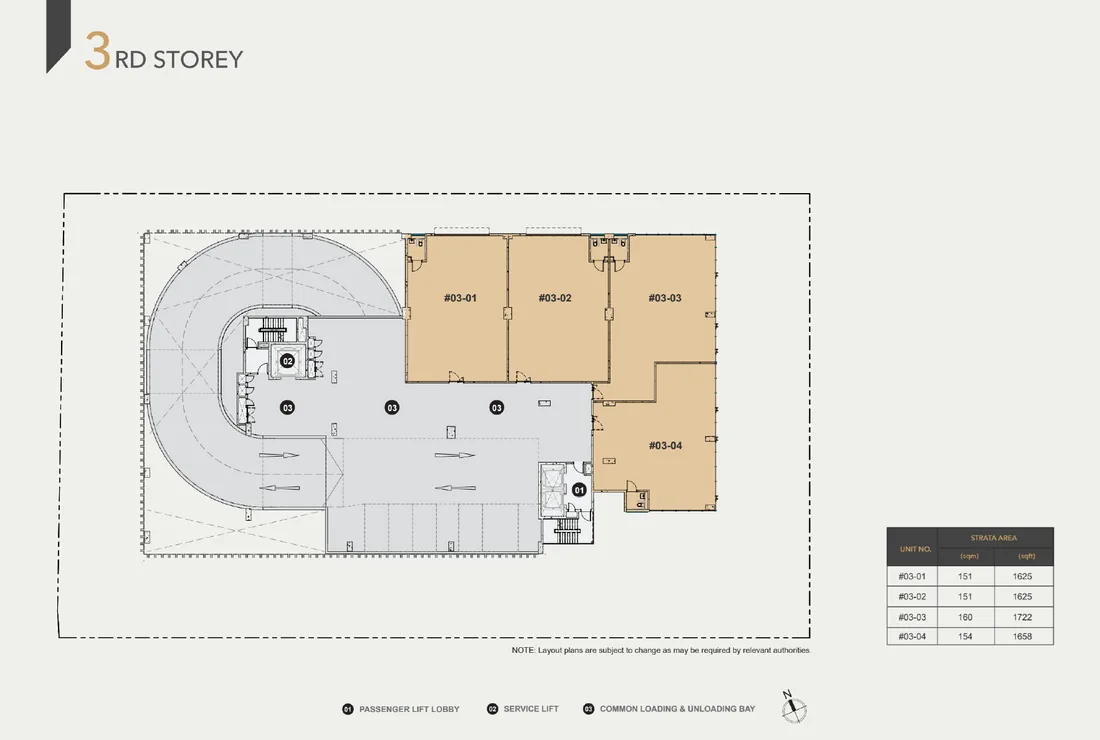
A loading bay is a logistics interface. It affects how trucks approach, how your receiving team moves goods, and how long a delivery vehicle is tied up. In strata setups, the layout and access design tend to matter even more because you are not operating in a standalone building with full internal control. You are operating inside a shared building with defined circulation paths, lift provisions, and loading arrangements.
The verified context highlights a key point: ramp-up factories provide direct vehicular access to units for loading and unloading, while flatted factories are generally accessed via common corridors, lifts and loading bays. That difference is not just a comfort preference. It changes your fit-out strategy, your packaging and palletisation approach, and sometimes your equipment choice.
In practice, the biggest operational failures I have seen usually come from one of these mismatches:
- the business assumes “dock-style” receiving but the unit configuration pushes you toward lift-based movement
- the business expects frequent truck turns but the building’s receiving rhythm cannot support that pattern smoothly
- the business wants a larger footprint for staging, but the approved use framework and the physical layout reduce staging flexibility
A loading-bay provision can also affect how fast you can respond to demand spikes. For example, an e-commerce packing operation may be less sensitive to where the bay is relative to the goods lift, as long as movement from dock to packing floor stays predictable. A trade that relies on heavier goods movement or tight scheduling tends to care a lot more.
The verified context also notes that key technical checks for strata industrial units include floor loading, ceiling height, goods-lift access, loading-bay provision, and whether the trade matches the approved use. If you only check floor loading and ignore goods-lift access or loading-bay provision, you can end up designing a workflow that runs perfectly in a spreadsheet and fails on the ground.
B1 vs B2: trade expectations and “heavier” realities
B1 and B2 are both industrial zoning categories, but they point to different operational profiles. B1 is described as clean or light industry and related uses. B2 is the heavier-industrial category. The verified context also indicates that JTC listings for B2 units commonly show higher floor loading and different height specs than B1 flatted factories, reflecting heavier use potential.
This matters because zoning expectations often mirror technical allowances. Even if you can physically move your items in and out, the unit and its approved parameters have to support the way you operate. If your plan leans toward heavier industrial activity, B2 may be the more aligned category. If your plan is “clean manufacturing, packing, publishing, media, and similar clean uses,” B1 tends to be the more natural fit.
To be clear, I am not saying B1 cannot support serious industrial work. I am saying you should treat B1 as a specific operational lane. Once you decide which lane you are in, the loading-bay provision and internal logistics have to support that lane reliably.
A trade-fit test that goes beyond “can we apply”
Most people in the market do a quick legal and zoning check, then move on to the building brochure. That is where you can lose months.
Because for B1 units, the use-quantum constraint means your operational footprint should match the approval logic. At least 60% of the floor area or GFA must be used for industrial purposes. The remaining area is limited to ancillary or supporting uses and approved secondary uses.
Here is a practical way to test trade fit without getting lost in abstract terms. First, map your workflow into “industrial activities” versus “supporting activities” in a way that is consistent with how you would explain it during approval processes. Second, estimate space usage, not just staffing. Third, check whether your receiving and movement requirements are compatible with loading-bay provision and goods-lift access.
If your packing is genuinely industrial and your staging and admin are ancillary or supporting, that can work well. If you are trying to run a mostly non-industrial operation inside the unit and rely on a few industrial tasks to “hit 60%,” the plan may collapse under scrutiny or become operationally awkward.
Due diligence checklist I use before making an offer
- Verify loading-bay provision and how vehicles interface with the receiving flow
- Confirm goods-lift access and whether movement patterns match your packaging and pallet sizes
- Check floor loading and ceiling height against your intended equipment use
- Align your planned activities with B1 industrial purposes and the 60% use-quantum logic
- Ensure the approved use matches the actual trade you will operate, not the trade you hope to operate later
That checklist is deliberately narrow. It is where most operational mismatches hide.
Strata industrial units Singapore: why “private ownership” still behaves like a system
Strata industrial units Singapore buyers often feel they are purchasing control. You own a specific unit, you fit out to your preferences, and you do not share your internal layout with other tenants. That is true at a micro level.
At a macro level, your loading-bay experience depends on the building’s design and how other users move goods. In flatted setups, access via common corridors, lifts, and loading bays means your workflow interacts with shared movement patterns. If you are planning ramp-up industrial units Singapore style operations, you need to be honest about whether your unit type gives you direct vehicular access or whether you are in the lift-and-bay world.
Ramp-up factories are described as providing direct vehicular access to units for loading and unloading. That is a major advantage for workflows that depend on frequent receiving or on heavier handling that is easier when trucks can come close. Flatted factory access via common corridors, lifts and loading bays can still work, but you should treat it as a constraints-driven design.
City-fringe industrial precincts: trade fit meets logistics distance
City-fringe industrial property Singapore areas such as Tai Seng, Paya Lebar, Ubi, Kallang and MacPherson are often favoured for e-commerce, light manufacturing, R&D and urban logistics because they sit closer to workforce catchments and transport links. The verified context also notes that URA B1 industrial clusters appear around city-fringe MRT areas.
That pattern is not about marketing. It is about reducing friction between people, deliveries, and last-mile movement. If your operation depends on quick workforce availability and tight turnaround from receiving to dispatch, city-fringe location can help your overall system.
But even in city-fringe precincts, the loading-bay and goods movement constraints remain. Proximity does not fix a weak goods-lift workflow. It only shortens travel time for people and vehicles arriving at your building.
When I evaluate a unit in one of these precincts, I ask a slightly different question than I would for a more industrially remote estate. I ask how your receiving schedule overlaps with building access patterns and whether the logistics rhythm is realistic day after day. If you operate in short-cycle batches, lift-based movement can be manageable. If you operate in heavy, high-frequency receiving windows, you want to know early whether the loading-bay provision actually supports that cadence.
Freehold vs leasehold industrial Singapore, and the “real” impact on decisions
The market often frames freehold industrial property Singapore as the safer bet because you avoid future land rent discussions. That is a reasonable instinct, but the verified context adds an important nuance: freehold industrial space is relatively scarce in Singapore because much new industrial supply is on leasehold land. JTC estate and unit pages commonly show lease terms such as 60-year, 30-year or 20-year lease terms for industrial sites, depending on the estate and product.
What I take from that is not that freehold is always better, or leasehold is always risky. It is that availability drives bargaining power and purchase strategy. If you are shopping for a specific trade fit and you find a leasehold unit that works technically and operationally, the lease term may matter less than people expect, provided the unit’s design and approved use remain compatible with your business over the intended holding period.
If you are specifically targeting freehold, you should still use the same technical lens. The loading-bay provisions, goods-lift access, and use-quantum logic do not become less important just because the tenure feels more secure.
B1 industrial property Singapore and new launch expectations
New launch industrial property Singapore is often sold with promises about modern specs, fresh fit-out potential, and improved flow. Those are not guarantees. They are hypotheses you still have to confirm through the unit’s technical checks and the approved use framework.
The verified context does not provide unit-by-unit specs for any particular new launch. So the sensible approach is to treat “new” as an opportunity to validate the fundamentals: floor loading, ceiling height, goods-lift access, and loading-bay provision, then tie those to your trade fit under B1 use-quantum rules.
When you do that, you can distinguish between improvements that matter operationally and improvements that matter mainly on the brochure.
Industrial property stamp duty Singapore, and what to expect on buying and selling
Stamp duty planning can be deceptively simple in headlines, and then complicated when you are actually preparing the transaction.
From the verified context, industrial property is not subject to Additional Buyer’s Stamp Duty. ABSD is described as applying to residential property acquisitions. Industrial transactions are instead subject to the normal BSD rules, and on disposal, seller’s stamp duty for industrial property applies where applicable.
Seller’s Stamp Duty (SSD) for industrial property disposal is based on holding period. The verified context states the rates as 15% if sold within 1 year, 10% if sold within 1 to 2 years, 5% if sold within 2 to 3 years, and none after 3 years.
One operational implication I have learned to respect: even if a unit’s technical fit is excellent, your exit horizon affects your costs. If you anticipate a short holding period because you are running a trial project, a ramp-up industrial units Singapore style experiment, or a business that might pivot quickly, the SSD schedule can materially change the economics of the trade.
Industrial property loan Singapore: financing is partly about how lenders classify the asset
Industrial property investment Singapore buyers often ask whether financing behaves like residential. The verified context indicates that industrial buyers are often assessed differently from residential buyers by lenders. MAS materials and market practice suggest financing depends on lender assessment, and non-residential loans are typically under commercial terms rather than residential housing-loan rules.
That matters for decision-making because your cashflow plan needs to be robust to credit assessment outcomes. You might be able to buy, but the structure of the loan, approval timelines, and the lender’s comfort with the asset’s specifications and use can shift your timeline.
I do not recommend treating financing as a background task. Treat it as part of the operational plan. A slightly better loading-bay provision that reduces downtime could make the unit easier to underwrite if it translates into predictable revenue. That is not guaranteed, but it is a logical connection between the way you operate and the way investors and lenders assess risk.
Buying under company name: when it fits the business reality
Buying industrial property under company name is common for industrial assets used for business or held for investment. The verified context also notes that IRAS stamp-duty rules treat entities differently mainly for residential ABSD purposes, while industrial SSD rules can apply on disposal regardless of buyer profile.
So if you are using a company structure because that aligns with your operational accounting and investment approach, you can focus on industrial SSD implications when planning your holding period. Your stamped cost on buying may not mirror residential ABSD assumptions, and that difference can influence how people size their purchase budget.
Again, I am staying at the level the verified context supports: industrial SSD depends on holding period and the rates provided, while ABSD is described as applying to residential property acquisitions.
“Is it suitable?” is not a single question, it is a trade conversation
The biggest mistake I see in discussions about buying industrial property Singapore is when people ask whether a unit is suitable as if “suitable” is one dimension. In reality, it is a bundle:
- Is the B1 vs B2 zoning aligned with your use and equipment intensity?
- Does the 60% use-quantum logic hold for your actual operations, not a pitch?
- Can the loading-bay provision support your receiving and staging cadence?
- Can goods-lift access handle your pallet and movement requirements without constant workarounds?
- Are floor loading and ceiling height compatible with your installed equipment and storage plans?
City-fringe precincts like Tai Seng and Paya Lebar can be a strong match for e-commerce, light manufacturing, and similar clean uses. But even there, trade fit and loading mechanics still decide whether your business runs cleanly or grinds down under daily friction.
If you are comparing options, you can also think of it like this: location optimizes the supply chain. Loading-bay provision and goods movement optimize your operations. Zoning and use-quantum optimize your compliance reality. Together they determine whether your unit feels like an asset or a permanent workaround.
Practical scenarios: matching the unit to the business
To make this concrete, here are a few scenario patterns, explained in operational terms rather than as fictional guarantees.
First scenario: a clean packing and processing workflow that depends on predictable inbound deliveries. If the unit has a clear loading-bay provision and goods-lift access that matches your movement style, you can design a smooth flow from receiving to packing without excessive cross-traffic. In this scenario, B1 can be a comfortable fit if your industrial portion stays meaningfully above the 60% floor area/GFA use-quantum requirement.
Second scenario: a trade that leans toward heavier Space Nova New Industrial Road handling, more equipment intensity, and higher floor loading needs. If your operation resembles the “heavier industrial category” more than B1’s light and clean intent, B2 becomes a more logical starting point. The verified context suggests B2 units commonly show higher floor loading and different height specs than B1 flatted factories, reflecting heavier use potential. That is the clue you should not ignore.
Third scenario: a business that plans to scale up quickly or adjust its operating model within a short window. Here, logistics flexibility matters. Ramp-up industrial units Singapore style access, where provided, can reduce friction as volume changes. If you are in a flatted factory arrangement with reliance on common corridors, lifts and loading bays, scaling might still be possible, but your internal workflow design must be careful from day one.
Where strata industrial units Singapore tends to shine
Strata industrial units can be a strong fit when your business needs a manageable footprint, a clear industrial workflow, and the ability to operationalise quickly. They also suit investors who want the unit to be aligned with specific approved use requirements. The verified guidance on B1 use-quantum and allowable use direction is the anchor here, because it forces clarity. If you match the unit design to your industrial use profile, the compliance and operational story becomes coherent.
That coherence is also what matters for industrial property rental yield Singapore thinking. While the verified context does not provide numbers, it supports a clear principle: resale liquidity can be sensitive to approved use, lease tenure, strata size and building specs. In other words, the unit that works for your tenant profile is the unit more likely to attract matching demand later.
So rather than chase yield headlines, I focus on building a unit profile that is easy to explain and easy to operate.
Closing mindset: treat loading and trade fit as one system
If you remember one idea, make it this: loading-bay provisions and trade fit are not separate checklist items. They are interlocking design constraints. B1 zoning is not just “industrial.” It comes with a use-quantum expectation, and a general intent toward clean and light industry uses. Loading and movement design then determine whether you can execute that industrial intent without daily compromises.
When you evaluate a unit with that mindset, you stop comparing buildings only on tenure labels like freehold vs leasehold industrial Singapore, and you stop treating zoning as a checkbox. You start asking the real questions: Can trucks and goods move in a way that suits the work? Does your industrial activity occupy the meaningful portion of the GFA? Do the technical specs support the way you will operate, not the way you hope to operate later?
That is the difference between buying a unit you can technically occupy, and buying a unit that supports a business you can reliably run.